 ernest olu balogun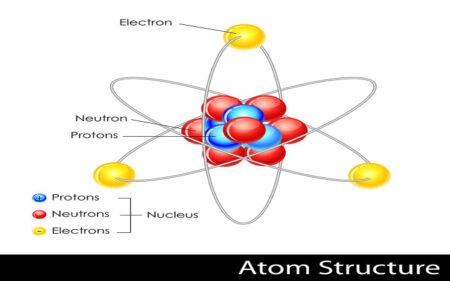
THE NATURE OF ELEMENTARY PARTICLES
If we peep into the atom the smallest indivisible part of matter, we enter into a new world of mysterious particles, known to the newbie as the world of protons, neutrons and electrons. If the story ended there it would have the pleasant end of a tightly knit story for particle physics, but this is not to be the case. Beyond the world of atom of proton, neutrons and electrons a new murky world of particle physics begins; the spy world filled with twists and turns of strange elementary particles.
Elementary particles are the smallest known building blocks of the universe. Although atoms were thought to be elementary, they too are composite objects. The atom, as first revealed in experiments by Rutherford, is an electrically neutral object, approximately 10 billionths of a centimeter in diameter. This means that there are about 2 million atoms stretching across the diameter of the period at the end of this sentence. Each atom has a tiny positively charged nucleus, about 10,000 times smaller yet. Negatively charged electrons occupy the space surrounding the nucleus. The mass of the electron is about 2,000 times lighter than the mass of the hydrogen nucleus: the proton. Electrons were the first of the modern elementary particles to be discovered.
The mass of most nuclei is about twice the mass of the protons they contain. The additional mass is provided by another particle, the neutron, which has a mass very close to that of the proton but is electrically neutral.
It is natural to ask what protons, neutrons, and electrons are made of. With today’s particle accelerators, one can “look inside” these objects for an internal structure. The proton and neutron are found to be made up of “quarks.”
There are many other particles that can be built out of the quarks combined in particular ways; these are called hadrons.
Physicists have also tried to see if there is anything smaller inside the electron. Experiments have the sensitivity to detect objects even 10,000 times smaller than the proton itself, but nothing has been found.
As far as physicists today know, quarks are also fundamental and are not made of yet smaller constituents. The question is still open experimentally, but theory and experiment are pointing more than ever before to the possibility that we have discovered the “ultimate constituents.”
Electrons are the negatively charged components of atoms. Electrons are surrounded by a cloud of other virtual particles constantly winking in and out of existence that essentially act as part of the electron itself. The electron has two heavier cousins, called the muon and the tau. Muons can be created when high-energy cosmic rays from outer space hit the top of Earth’s atmosphere, generating a shower of exotic particles. Taus are even rarer and harder to produce, as they are more than 3,400 times heavier than electrons. Neutrinos, electrons, muons and taus make up a category of fundamental particles called leptons.
Residing inside protons and neutrons are tiny particles called quarks, which come in six possible types or flavors: up, down, strange, charm, bottom and top.
Quarks, which make up protons and neutrons, are another type of fundamental particle. Together with the leptons, quarks make up the stuff we think of as matter.
Protons are made from two up quarks and a down quark, while neutrons are composed of two downs and an up. The up and down quarks are the lightest varieties. Because more-massive particles tend to decay into less massive ones, the up and down quarks are also the most common in the universe; therefore, protons and neutrons make up most of the matter we know.
Finally, there is the Higgs boson, the king of the elementary particles, which is responsible for giving all other particles their mass. Hunting for the Higgs was a major endeavor for scientists striving to complete their catalog of the Standard Model.
The Higgs looks pretty much exactly like it was predicted to look, but scientists were hoping for more. The Standard Model is known to be incomplete; for instance, it lacks a description of gravity, and researchers thought finding the Higgs would help point to other theories that could supersede the Standard Model. But so far, they have come up empty in that search.
Culled and edited with addition materials
From
What Are Elementary Particles?
By Adam Mann
.
